
In Aotearoa New Zealand, when an Elder, or Kaumatua in Te Reo Māori, slips away, we say, “A Mighty Kauri has Fallen”.
The Kauri tree is one of NZs’ most iconic trees and it is a suitable analogy for the loss of Professor Paul Ehrlich, my, Pauline and Professor Guy McPhersons’ friend and colleague. R.I.E.P. mate.
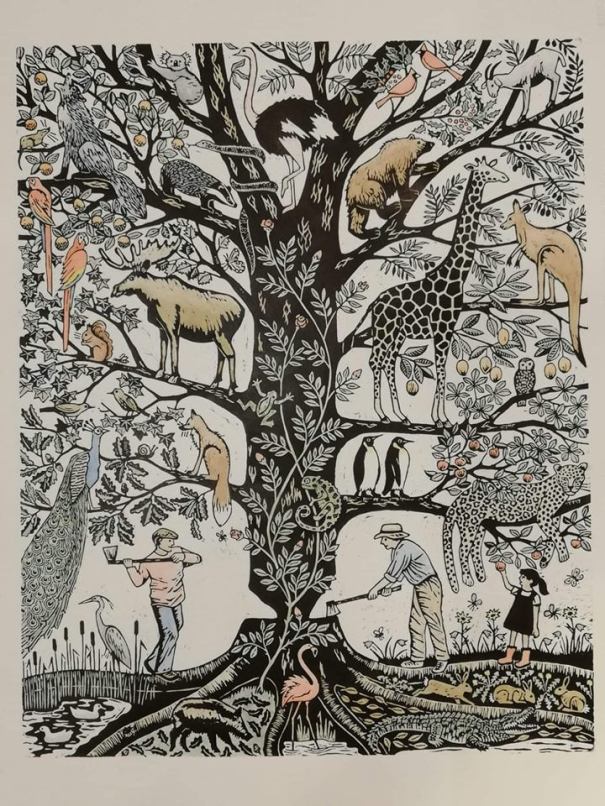
6th-mass-extinction-woodcut-print-by-Nat-Morley-2019
In the debate above we discussed Paul and my analogy about being on the Titanic. Class War on the Sinking Titanic
“Ehrlich founded Stanford’s Center for Nature and Society in 1984 and wrote more than 40 books and over 1,100 scientific articles on ecology, the environment and population dynamics. He is best known outside of academia for writing “The Population Bomb” in 1968, along with his wife, conservation biologist Anne H. Erhlich, who survives him.”
Paul Ehrlich, often called alarmist for dire warnings about human harms to the Earth, believed scientists had a responsibility to speak out
What is the MAHB?
The goal of the Millennium Alliance for Humanity and the Biosphere (MAHB) is to create a platform to help global civil society address the interconnections among the greatest threats to human well-being: climate disruption, loss of biodiversity (and thus ecosystem services), land-use change and resulting degradation, global toxification, ocean acidification, decay of the epidemiological environment, an economic system based on growth, pressure from increasing population, and resource wars (which could go nuclear). The manifestation of these interactions is often referred to as “the human predicament.”
A Tribute to Paul R. Ehrlich from World Vasectomy Day
We discussed Paul’s ‘last’ book, written in conjunction with Gerardo Ceballos and Rodolfo Dirzo.
Before They Vanish Saving Nature’s Populations — and Ourselves
“Can we save threatened animals and ecosystems in the midst of a mass extinction? The answer is a resounding yes! Before They Vanish shows us how. In this wise and impassioned book, renowned conservation scientists Paul R. Ehrlich, Gerardo Ceballos, and Rodolfo Dirzo urge us to shift our thinking rather than succumb to grief over the losses that humanity faces. This comprehensive look at a crucial but often overlooked aspect of conservation—population extinction, or the loss of a species within a specific geographic location—guides us onto a new, hopeful path.”
I mentioned the role that the Haber-Bosch process played in population overshoot, more details at Haber-Bosch process
Below is the last recorded debate I had with Paul, Guy, Pauline and other colleagues.
All of the debate notes and embedded links for the above show can be found at: Professor Paul Ehrlich, Nuclear Winter and the Unfolding Human Predicament.
As Elisabeth Robson wrote on her Substack post: Paul Ehrlich Was Early, Not Wrong
Readers can support this blog by Buying me a coffee to be honest, it will be a beer not really coffee or via Paypal :
I’m also on Bluesky, Facadebook and Twitter:
Asalamu Alaikum, Amandla ngawhetu, Tiocfaidh ár lá.

I'm an anti-imperialist, environmental activist and blue ocean sailor, who is passionate about the earth and all it's inhabitants without favour. Brace for imminent impact as we bare witness to the non-linear unraveling of the biosphere and habitability disappearing for most if not all complex life on the only habitable planet we know of. To quote President Niinistö in North Russia: ‘If We Lose the Arctic, We Lose the World’. Folks we have lost the Arctic.


 Kevin Hester
Leave a Reply