
“In this Climate Chat episode, we interview Dr. Vincent Gauci on how reducing air pollution results in increased atmospheric methane concentrations. Vincent Gauci is professor of Geography and Environmental Sciences and a Birmingham Professorial Fellow at the University of Birmingham in the UK. Professor Gauci investigates how the biosphere interacts with the atmosphere and he explores questions relating to how these interactions respond to various drivers of global change.”
“Article in The Conversation by Dr. Gauci titled “Reducing air pollution could increase methane emissions from wetlands – here’s what needs to be done”:
Reducing air pollution could increase methane emissions from wetlands – here’s what needs to be done
2025 Paper: “The large role of declining atmospheric sulfate deposition and rising CO2 concentrations in stimulating future wetland CH4 emissions”:
Follow Vincent on X/Twitter: @gaucigauci and Blusesky: @gaucigauci.bsky.social
I have previously on this blog delved into the Aerosol Masking Effect, what Dr James E Hansen calls “Our Faustian Bargain”. The embedded link below includes further research from our respected colleague Leon Simons: The Aerosol Masking Effect, a Deep Dive into Our “Faustian Bargain”
“As I have reported many times in this space, the rapidly melting ice and snow on the Arctic Ocean is a cause for serious concern. This is the climate factor over which we have the least control, individually and collectively. Shortly after we experience the first ice-free Arctic Ocean since civilizations have appeared on Earth, we will lose habitat for humans and almost certainly all life on Earth”
The Lede above and the video from Professor Guy McPherson and additional data are embedded as follows: Science Snippets: Another Source of Greenhouse Gases from the Arctic
Methane is a powerful greenhouse gas. Each molecule of methane—CH4—is equivalent to 84 molecules of carbon dioxide, according to Climate Change Connection.
An article at Phys.Org published on 3 February 2025 is titled Satellite data analysis uncovers top 10 persistent methane sources. Here’s the lede: “A list of the top 10 global regions where natural or anthropogenic sources emit methane on a continuous, ‘persistent’ basis was recently published in Atmospheric Chemistry and Physics.”
Responding to Persistent Methane Sources
There is a concerted attempt by some of the corporate media and their go to scientists to downplay the existential threat of CH4.
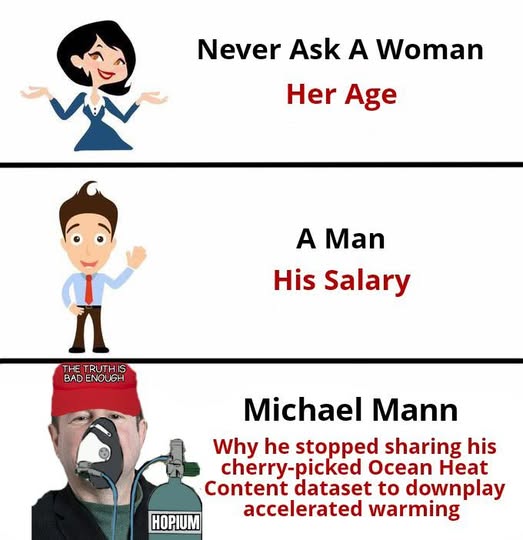
The liar in chief on that score is Michael E Mann.
He has completely compromised his own scientific integrity by denying the severity of the methane feedback loop to the point that there are dozens of scientists and researchers like me who have been blocked by Mann who miraculously came up, in conjunction with other colleagues, the much vaunted “Hockey Stick Theory”, which he can no longer see.
Follow the money.
As we incinerate the cryosphere we are seeing nonlinear emissions of methane from submarine hydrates, both in the Arctic and the Antarctic.
Research Highlight: Loss of Arctic’s Reflective Sea Ice Will Advance Global Warming by 25 Years
Do Not Go Gentle into That Good Night
By Dylan Thomas
Do not go gentle into that good night,
Old age should burn and rave at close of day;
Rage, rage against the dying of the light.
Though wise men at their end know dark is right,
Because their words had forked no lightning they
Do not go gentle into that good night.
Good men, the last wave by, crying how bright
Their frail deeds might have danced in a green bay,
Rage, rage against the dying of the light.
Wild men who caught and sang the sun in flight,
And learn, too late, they grieved it on its way,
Do not go gentle into that good night.
Grave men, near death, who see with blinding sight
Good luck everyone, flora and fauna, all things being equal, as it should be.
Blind eyes could blaze like meteors and be gay,
Rage, rage against the dying of the light.
And you, my father, there on the sad height,
Curse, bless, me now with your fierce tears, I pray.
Do not go gentle into that good night.
Rage, rage against the dying of the light.

I'm an anti-imperialist, environmental activist and blue ocean sailor, who is passionate about the earth and all it's inhabitants without favour. Brace for imminent impact as we bare witness to the non-linear unraveling of the biosphere and habitability disappearing for most if not all complex life on the only habitable planet we know of. To quote President Niinistö in North Russia: ‘If We Lose the Arctic, We Lose the World’. Folks we have lost the Arctic.


 Kevin Hester
Hi from Marietta, Ohio, in a time of full-on societal collapse and climate collapse! Thanks for your work and validating “likes” on many of my armchair climate researches. Here’s another. I understand GWP to be a measure of the heat absorption by a molecule of a GHG, CO2 being far outweighed by CH4, etc., and water vapor the least tenacious in holding the absorbed heat energy, especially as it rises and cools in the atmosphere. In fact, isn’t this the hydrological conveyor belt exhausting waste heat from the overheated surface and atmosphere? So, I get that CO2, CH4, etc. “bind” the heat energy more tightly, but not why this makes them more potent as global warming GHGs. A recent paper, I’ve misplaced, indicated the capacity of low clouds (water vapor) to reflect heat energy back to the surface, and we know that, by weight anyhow, water vapor is the most prevalent GHG.
So, aren’t we really talking about “apples and oranges”? It’s one thing to consider the individual heat retaining capacity of a GHG molecule, and, another thing then, the GWP of a GHG? Anyway, as you know, from the recent Hansen paper and the 6-5-24 C3S “Hottest May on record spurs call for climate action” paper, the annual GAST increase over the past 2 yrs. is 0.2 degC and appears to be on a continuing trend line, so 2 degC over the 1991-2020 baseline by 2027, 3 degC by 2032 and the extinction level 6 degC by 2047, right?
So, the big picture is that the earth’s surface/atmosphere is overheating, and even the 1.2 trillion tons of global ice melting (C3S), 321 million cubic miles of oceans absorbing 90% of the atmospheric heat surplus, or the 1 trillion tons of water vapor carrying heat energy to outer space, are unable to prevent the accelerating surface heating, right? I’m just an ole retired doc and armchair climate nerd, but I respect your opinion and seek your guidance.
LikeLiked by 1 person