
“This study considers the relationship between a global systemic banking, monetary and solvency crisis and its implications for the real-time flow of goods and services in the globalised economy. It outlines how contagion in the financial system could set off semi-autonomous contagion in supply-chains globally, even where buyers and sellers are linked by solvency, sound money and bank intermediation. The cross-contagion between the financial system and trade/production networks is mutually reinforcing.”
“It is argued that in order to understand systemic risk in the globalised economy, account must be taken of how growing complexity (interconnectedness, interdependence and the speed of processes), the de-localisation of production and concentration within key pillars of the globalised economy have magnified global vulnerability and opened up the possibility of a rapid and large-scale collapse. ‘Collapse’ in this sense means the irreversible loss of socio-economic complexity which fundamentally transforms the nature of the economy. These crucial issues have not been recognised by policy-makers nor are they reflected in economic thinking or modelling.”
The above two paragraphs from my 2023 article titled: Financial system supply-chain cross contagion – a study in global systemic collapse. I suggest readers dive into the stellar work of David Korowicz published on June 17, 2012 In the link above is a video explainer from David titled: “The Modern Economy, Civilisation, Complexity & Collapse”
The video is absolutely worth your time.
In it David taught me the term “Recursive” A set of precursors to cluster acquisition was thereby identified and shown to be recursive. We always underestimate complexity.
I was motivated to revisit this issue when the banking crisis in Paraguay raised its ugly head. Then, one thing led to another.
“Paraguay’s central bank board voted unanimously to place Ueno Bank into resolution after its solvency ratio collapsed to below half the legal minimum, locking out roughly 3 million customers — an estimated 60% of Paraguay’s adult population.”
“Paraguay’s state pension and healthcare fund, the IPS, has approximately $380 million in Ueno bonds and term deposits at risk, with 32,000 retirees who collected pension payments through the bank awaiting transfer to a new institution.”
“Central Bank president Carlos Carvallo — who led Ueno’s predecessor institution before President Santiago Peña appointed him as Paraguay’s top financial regulator — has resigned at Peña’s request, while opposition lawmakers move to draft an impeachment motion against the president.” Paraguay’s Banking Collapse Exposes a Trail of Political Ties That Leads Straight to the Presidency
Three million people woke up to the reality that they were now broke, no warning, just a blank screen where once was their lifesavings, just like that. So far, it hasn’t triggered contagion, but even dominos have a lag between cause and effect, and we can be sure that all the banks and their investors are trying to figure out how the collapse effects them.
The following from Dean Blundell on Substack:
BROKE: The Biggest Bank in America Just Locked Customers Out of Their Own Money as 5 Major Banks Announce MASSIVE Outage
“The biggest bank in America broke on a Monday, two days after nationwide FAA outage, 5 days after Microsoft outage, and the best they’ve got is “technical bug.” HMMM. Sleep tight, everybody.” Dean laconically points out that none of these people are now sleeping.
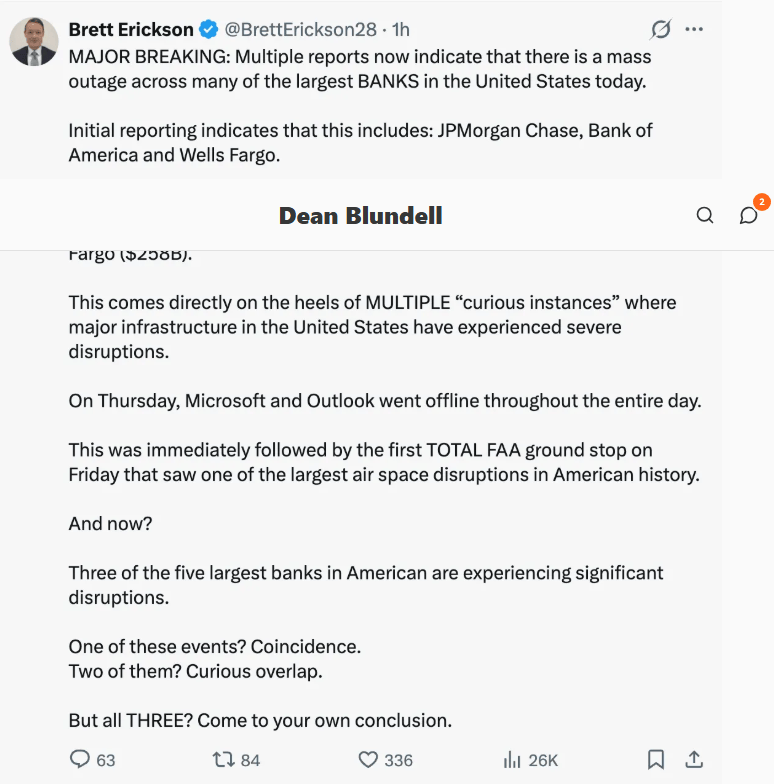
“Around mid-morning Eastern, Chase customers opened their apps and got a cheerful little note saying some services aren’t available and to please try back later. By 2 pm, more than 5,000 people had filed complaints on Downdetector. Half of them couldn’t see balances or transactions. Roughly a quarter couldn’t log in. Nearly one in five were reporting busted transfers and wires. People said they couldn’t cash cheques, couldn’t withdraw, couldn’t get a cashier’s cheque processed. Reddit filled up with customers claiming tellers told them the systems were down inside the branches too.”
“Chase’s official response is a masterpiece of the genre. A spokesperson said that due to a technical issue, some transactions are taking longer than usual, but customers still have access to their accounts and funds.”
“Access to their accounts. The accounts they can’t log into. That’s like the airline telling you your luggage is completely safe while you watch it circle a carousel in a different country on your “Find My” iPhone app.”
The five paragraphs and screenshot above from Dean Blundell’s great piece titled: BROKE: The Biggest Bank in America Just Locked Customers Out of Their Own Money as 5 Major Banks Announce MASSIVE Outage Many thanks Dean.
Let’s have a contemporaneous dive into contagion. The following, via an article in Investopedia published: By Akhilesh Ganti Updated October 03, 2026 titled: Financial Contagion Explained: How Crises Spread Globally
Key Takeaways
Strong markets provide buffers, while fragile markets magnify negative shocks.
Financial contagion spreads economic crises from one region to another.
Markets interconnected through financial systems amplify economic shocks.
Effective regulation and banking policies help prevent financial contagion.
The 1997 Asian financial crisis showcased the concept of financial contagion.
What Is Financial Contagion?
Financial contagion is the spread of an economic crisis from one market or region to another and can occur at domestic and international levels. The contagion can affect goods and services, labor, and capital goods used across markets connected by monetary and financial systems.
“The 1997 Asian financial markets crisis was among the first examples of the term being used. The real and nominal interconnections of markets can propagate and even magnify economic shocks, likening the effect to the spread of a disease like a contagion.1“
Impact of Financial Contagion on Global Markets
“Financial contagion is defined as a shock that initially affects a few financial institutions and spreads to the rest of the financial system, commonly infecting the economies of other countries. Contagions are typically associated with the diffusion of crises throughout a market, asset class, or geographic region. A similar effect can occur with economic booms. The phenomenon of financial contagion has implications for portfolio management, trading, hedging, and diversification strategies.2“
Now some video confirmation of the precarity of our predicament.
“Michelle Makori, President & Editor-in-Chief of Miles Franklin Media, speaks with Andy Schectman, Founder & CEO of Miles Franklin Precious Metals, about growing vulnerabilities in the global financial system, recent technology outages, and the risks of relying on interconnected digital infrastructure.”
In this episode of The Real Story with Michelle Makori:
Physical precious metals and wealth preservationFinancial system vulnerabilities and the risks of digital dependence.
Tokenized gold, Project Ensemble, and China’s CIPS network.
Why major players are accumulating physical gold and silver.
The $40 trillion U.S. debt burden and the dollar’s future.
A fascinating aspect of listening to ‘financial advisers’ is that they can grasp crashes, but actual collapse is a bridge too far for them to consider.
That quote from John Kenneth Galbraith keeps popping up. “People of privilege will risk their complete destruction before relinquishing any material portion of their advantage”.
The unsustainable can’t be sustained indefinitely, like a Jenga stack, it gets progressively more unstable, then collapses.
I’ve been trying to make the point that collapse isn’t an event, it’s a process, clearly a process that is underway, and accelerating.
We’re in the unstable phase. Draw your own conclusions as to what happens next.
Previous work from me in this space with William Catton and Joseph Tainter.
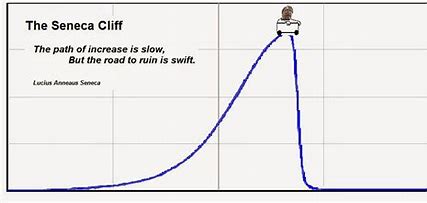
“What we are actually living through right now is a slow, accelerating unraveling across the infrastructure that modern life depends on. People sense it.”
The Big One Is a Distraction from the Slow Collapse
“A single apocalyptic AI event makes for dramatic headlines and excellent fear content, but the record shows something far different. When Microsoft Outlook went down, then the FAA grounded flights, then Chase Bank’s systems fritzed, then the NSA admitted internal disruptions, the honest reading was not one coordinated cyber-apocalypse — it was a pattern of fragility finally becoming visible to ordinary people” Systems Are Failing Faster — Why Preparedness Beats Panic
I’ll end with one of the penultimate quotes in the David Korowicz presentation embedded earlier: “One of the things I have found is that the ‘Doomy’ people, to be some of the most levelheaded, smiley, humorous, whatever, which kind of says something, so I’ll leave it at that.”
I’ve found exactly that, in all sorts of different manifestations, everyone has their own perspective of ‘collapse’.
I’ve had quite a lot of experience with ‘Hospice’ from personal experience and then interviewing Stephen Jenkinson, “The Grief Walker’ who is now tragically navigating his own hospice, aren’t we all.
I’d rather hang out with realists than anyone else, we need to form tribes again and navigate this, whatever this is, with trusted comrades and crew mates, as we sail off into the perfect storm!
Readers can support this blog by Buying me a coffee to be honest, it will be a beer not really coffee or via Paypal :
I’m also on Bluesky, and Twitter: My Facadebook profile has been taken down by Mr Z for a single comment on a friend’s thread about Russel Brand, where I wrote “It’s only a matter of time before Russel learns what it’s like to be raped” Mentioning the Epstein classes and genocide is now frowned on! Holding a sign in the not very United Kingdom saying “I Support Palestine Action” is a criminal offence, supporting the dismemberment of tens of thousands of children isn’t! They can take that ‘civilization’ and shove it where the sun doesn’t shine.
Asalamu Alaikum, Amandla Ngawhetu, Tiocfaidh ár lá.

I'm an anti-imperialist, environmental activist and blue ocean sailor, who is passionate about the earth and all it's inhabitants without favour. Brace for imminent impact as we bare witness to the non-linear unraveling of the biosphere and habitability disappearing for most if not all complex life on the only habitable planet we know of. To quote President Niinistö in North Russia: ‘If We Lose the Arctic, We Lose the World’. Folks we have lost the Arctic.


A great riff on the same topic: https://open.substack.com/live-stream/463074?utm_source=email&utm_campaign=new-live-stream-email
LikeLike