Ignoring thousands of years of Anthropogenic emissions sealed our fate. A microcosm of “our collapsing civilization”, which is now unfolding in a non-linear, exponential fashion, as the six-dozen feedback loops we have triggered and ignored, kick in and kick us and all other earthlings, towards oblivion, and extinction. The corporate controlled and created IPCC use 1880 as their “Pre-Industrial Base line”. It’s morally and scientifically bankrupt, disingenuous and fascist when we know that the outcome of these obfuscations is so catastrophic, not just for us, but for all complex life on our “Pale Blue Dot“. Any individual signing their name on a document from the IPCC is colluding with the enemy! Professor Guy McPherson and I know exactly how frustrated Carl Sagan felt as he tried to point out the precipitous collapse we were & still are racing toward. Emissions have much more than doubled since Carl Sagan addressed the US congress in 1985.
The purpose of this post is to show that Industrial civilizations existed thousands of years prior, and we haven’t accounted for those emissions. This is a deliberate strategy to deceive the public about how much emissions we have dumped into the atmosphere and the baked in consequences. Even Dr James E Hansen, the “Grandfather “of climate change admits that 10C is baked in! The latest science indicates that 14C minimum is now unavoidable! I’ve covered this aspect of collapse earlier: Baseline Temperature dishonesty at the Edge of Extinction The incredible Sam Carana from Arctic News Blogspot calculated that “Using 1750 as a baseline we are at or around 2c. Going back in time to include the Iron Age and Bronze ages we are at least 2.29C, hence all the chaos unfolding now, not at some long off date we’ll never get to see.” That quote from my article “Current Climate Path Will Lead to Collapse of Life on Earth.” I’d just like to point out that the title of the above article comes from The Independent, a corporate outlet that let the cat out of the bag! I’m pleasantly surprised that the title got past the editor! “Between the 13th and 11th centuries BCE, most Greek Bronze Age Palatial centers were destroyed and/or abandoned.” ” A sharp increase in Northern Hemisphere temperatures preceded the collapse of Palatial centers, a sharp decrease occurred during their abandonment. Mediterranean Sea surface temperatures cooled rapidly during the Late Bronze Age, limiting freshwater flux into the atmosphere and thus reducing precipitation over land. These climatic changes could have affected Palatial centers that were dependent upon high levels of agricultural productivity. Declines in agricultural production would have made higher-density populations in Palatial centers unsustainable. The ‘Greek Dark Ages’ that followed occurred during prolonged arid conditions that lasted until the Roman Warm Period.”
“At the end of the Late Bronze Age (LBA) most Eastern Mediterranean urban centers were either destroyed or abandoned throughout the Near East and Aegean”. In the excellent video below temperatures of over 1200C were generated to make steel over 1000 years ago, imagine how much fuel and by default emissions of CO2 that involved.” The influence of climatic change on the Late Bronze Age Collapse and the Greek Dark Ages Introduction
In the fascinating video above it is mentioned that this technology evolved from the cradle of humanity in West Asia. The current emperors of the Military Industrial Congressional Complex are bombing that region back into the stone ages. Those same monsters have just installed their proxy army Al Qaida into Syria, as always, it’s a land and resources grab, intrinsically linked to “Peak Oil”.
My colleague and dear friend Professor Guy McPherson adds’ his thoughts on the dishonesty here: Science Update: Shifting the Baseline If the above videos interested, click on the link above for Professor McPhersons video analysis that for some reason? WordPress won’t allow me to embed!!! To get the most from this article drill down into the embedded links. When reading corporate media, remember they have share prices to maintain, keeping you and your children in the dark is a cynical economic decision. Feel free to add your own comments below and subscribe to the blog to join the crew on this final voyage. Brace for imminent impact. You can support this blog by Buying me a coffee to be honest, it will be beer not coffee or via Paypal : I’m also now on Bluesky as below: https://bsky.app/profile/climatekevnz.bsky.social
“Microplastics exert tremendous influence over the living planet. I can hardly read a headline at a corporate media outlet without learning more about the enormous influence of microplastics. They’re in our water. They’re in our food. They’re in our blood. They contaminate beaches throughout the world.”
“Here’s the lede, followed by another sentence that completes the first paragraph: “Microplastics in the atmosphere may be altering weather and climate by facilitating ice formation in clouds. Penn State research suggests these particles could impact precipitation and climate patterns, though their full effects remain unknown.”
“Of course, “their full effects remain unknown.” As Professor and Science Educator Carl Sagan pointed out long ago, “Science is a way of thinking much more than it is a body of knowledge.” We will never know all there is to know about Earth, much less the universe we inhabit. Science is a means of accumulating reliable knowledge through observation and testing. However, complete knowledge is beyond us, as indicated in the next paragraph of the article at SciTechDaily: “Scientists have discovered microplastics—tiny plastic particles less than 5 millimeters in size—in some of the planet’s most untouched places, from the depths of the Mariana Trench to the snow-capped peak of Mt. Everest, and even in clouds over mountains in China and Japan. Microplastics have also been found in human brain tissue, inside sea turtles, and even within plant roots. Now, new research led by Penn State scientists suggests that these airborne microplastics could be influencing weather patterns and impacting the climate.”
All of the above information has been drawn from Professor Guy McPhersons Substack post, link embedded below. Readers can subscribe for free and for a small scoop of ice-cream can join the discussion: Science Snippets: Microplastics Changing Earth’s Climate
In January 2021 Professor McPherson and I interviewed Oceanographer Jim Massa, below is a similar analysis from Jim concentrating on the plastic predominantly in the oceans.
“Seventy four metric tonnes of microplastics have been found in Auckland’s atmosphere, the equivalent of three million plastic bottles per year, researchers say.”
“The University of Auckland research, published in Environmental Science & Technology, found the microplastics were of such small sizes that there was concern they could be inhaled and accumulate in the human body.”
“Nanoplastics, the smallest particles, can potentially enter cells, cross the blood-brain barrier, and may build up in organs such as the testicles, liver and brain. Plastics have also been detected in the placenta.”
“Microplastics have also been detected in human lungs and in the lung tissue of cancer patients, indicating that the inhalation of atmospheric microplastics is an exposure risk to humans,” the paper noted.”
“The levels of microplastics in Auckland’s air were much higher than those recorded in London, Paris and Hamburg in recent years, with the study utilising a method which could detect particles as small as 0.01 of a millimetre, researchers said.” If you ever wondered why everyone is getting sick, factor plastic into the toxins we ingest. Airborne microplastics in Auckland equivalent to millions of plastic bottles per year
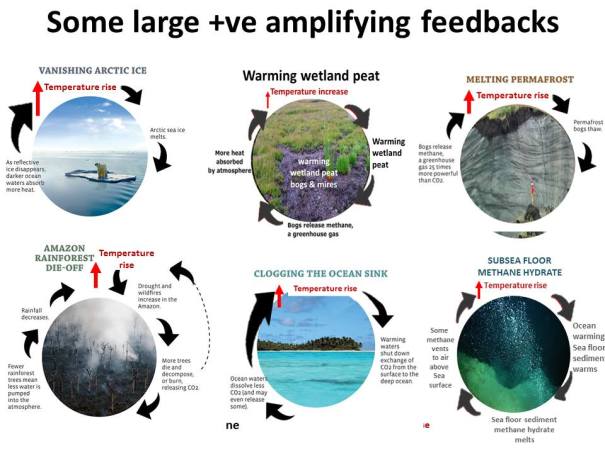
I’m not surprised by this catastrophic new paper; I have been expecting to see ‘step changes’ in the climate system and the multiplicative consequences of the six dozen feedback loops that Professor Guy McPherson has identified. As Professor Peter Wadhams pointed out to Guy, the feedback loops are multiplicative, not ‘only’ additive!
In May 2019, I woke up to find that Professor Peter Wadhams, possibly the most experienced scientist in the world when it comes to Arctic Sea Ice, had posted the following response to the blog post:
“The analysis of climate sensitivity by David Wasdell is very important. I have been through it with him several times and am convinced of its validity. I mentioned it in “A Farewell to Ice”. The point is that here is a big difference between the short term sensitivity, which is used to calculate warming over a few years, and the long term sensitivity which represents how much warming the earth is going to be subjected to if you don’t add more CO2 but let the effects of the present levels work their way fully through the climate system. Short term sensitivity is 2-4.5 C, but long term is more like 10C. The crime of IPCC and other modelling outfits is that they are aware of this difference between short and long term, but still use the short term value even when they are doing hand-waving studies of what is going to happen over the next century or two. In fact it’s not just the case that the magic 1.5C or 2C warming is already “baked in” to the global system – in fact the baked in figure is more like 4-5 C. Hence the vital need for carbon drawdown. Best wishes Peter Wadhams”
Now with new analysis, we find that 14C is baked in!
I’ll finish with a quote from the late great Albert Bartlett: “The Greatest Shortcoming of the Human Race is our inability to truly understand the exponential Function.”
He too has been proven correct. How quickly will this unravel? The great unravelling is clearly underway. My personal view is that we are now a day-to-day proposition. We’ve hurtled off the cliff after decades of ‘Kicking the can down the road”, now that we’ve driven the ecosystem off the cliff, this entire shitshow could unravel between when you go to sleep and when you wake up! I was in Berlin one week before the “Berlin Wall” came tumbling down. There had been demonstrations in Leipzig that week but there was no hint that the GDR would completely collapse, but it did. Soon after the USSR collapsed. Our weakest link is “Complexity”, I’ve previously considered that aspect of collapse in my blog post: The Myth of Human Progress and the Collapse of Complex Societies. Chris Hedges & Joseph Tainter.
Good luck everyone, we sure are going to need it, soon we’ll all be walking around looking as stunned as the people in Valencia Spain after the latest deluges in Europe!
“The sea is only the embodiment of a supernatural and wonderful existence. It is nothing but love and emotion; it is the Living Infinite…” Jules Verne
“Because of social taboos, despair at the state of our world and fear for our future are rarely acknowledged. The suppression of despair, like that of any deep recurring response, contributes to the numbing of the psyche. Expressions of anguish or outrage are muted, deadened as if a nerve had been cut. This refusal to feel impoverishes our emotional and sensory life. Flowers are dimmer and less fragrant, our loves less ecstatic. We create diversions for ourselves as individuals and as nations, in the fights we pick, the aims we pursue, and the stuff we buy.” The Greatest Danger; Joanna Macy
My ancestors were born on the island called Ireland/Éire, militarily occupied by the British for 800 years, divided for over a 100, by some fluke of chance my darling parents emigrated to Aotearoa New Zealand. Had I been born in the war zone, there is zero chance I would have survived my twenties! Adventures of a Member of the Diaspora in Occupied West Belfast Dad arrived in NZ in 1957, to build the Auckland Harbour Bridge, he was the first person to need the decompression chamber at Devenport Naval Base, in an emergency, his timing to get the Bends whilst constructing the concrete piers on the bridge, was near perfect, the chamber had only just been installed, less than a mile from the construction site! The luck of the Irish huh? I’ve been reasonably careful as a diver because the ‘old man’ nearly succumbed to the Bends. Ma arrived in Aotearoa New Zealand with my three of my older siblings two years later in 1959, I arrived on the planet in 1960. As an adolescent I became fixated on the oceans, mainly through watching Jaques Cousteau, as he explored the ocean depths, I was “Hooked”, pardon the pun!
Fascinatingly, in the above video, Jaques once blew up a reef, it was only later did he understand the implications of what he had done and what could and did happen on an industrial scale!
A wonderful consequence of my addiction was I obtained my yacht skippers ticket, in Gibraltar of all places, and I went on to do 16 ocean passages on small yachts, more than half as skipper. Two of those tales are embedded below! The transit of the Mediterranean detailed below doesn’t count as an ocean passage because the Med’ is considered to be an almost non-tidal, inland sea. A Conversation Between a French F111 Fighter Jet Pilot, a Kiwi Yacht Skipper and Everything in Between. Shark Attack at Minerva Reef Neither of the experiences above nor the other 15 ocean passages would have happened in my life without the inspiration of Jaques Cousteau. Five years ago, I was interviewed by the late great Michael Dowd, I spoke about how Jaques had changed my life!
One day after my birthday, on the 11 of March 2011, my worst nightmare came to fruition, with the triple melt downs at Fukushima Daiichi. I had some sleepless nights when I couldn’t stop grieving for the chaos, I had failed to prevent. It was gut wrenching!
There is a multi-decadal lag between emissions and when their full consequences manifest, for massive pulses of carbon, it can take centuries to work its way through the climate system. “In a recent letter, Ricke and Caldeira (2014 Environ. Res. Lett. 9 124002) estimated that the timing between an emission and the maximum temperature response is a decade on average. In their analysis, they took into account uncertainties about the carbon cycle, the rate of ocean heat uptake and the climate sensitivity but did not consider one important uncertainty: the size of the emission. Using simulations with an Earth System Model we show that the time lag between a carbon dioxide (CO2) emission pulse and the maximum warming increases for larger pulses. Our results suggest that as CO2 accumulates in the atmosphere, the full warming effect of an emission may not be felt for several decades, if not centuries.” The time lag between a carbon dioxide emission and maximum warming increases with the size of the emission
All the unfolding chaos we are witnessing today, is from emissions from last century and before, effectively this centuries consequences, have yet to manifest! The lag in the climate system is a critical detail!
There is a tsunami of grief building in our human community, especially in our youth, we need to talk about it publicly so that everyone can see that they are not alone. The Coming Tsunami of Grief The article below was written by Professor Henry Gee, he is the senior editor at Nature.com one of the most influential peer reviewed journals. Habitat degradation, low genetic variation and declining fertility are setting Homo sapiens up for collapse. Humans Are Doomed to Go Extinct I’m editing into this blog this amazing video about Jaques Cousteau’s adventures and candidly his mistakes of blowing up reefs as part of a science project! Videos https://www.youtube.com/watch?v=v8Jhgj12VF4
Kevin Hester is currently living on Rakino Island, a small island in the Hauraki Gulf near Auckland, New Zealand, monitoring the unravelling of the biosphere and volunteering at the Rakino Island Nursery is currently developing a proposal to create a marine reserve near by. The Island has no grid tied electricity or reticulated water. I catch my own water from the roof and generate my electricity from the ample solar radiation on the island.
My Submission to the Ministry of the Environment
Kevin Hester, Dropping Anchor in an Exponential World




 Kevin Hester